Client Story #01
How a European intimates brand turned a 24-SKU cashmere dream into reality — without betting 7,200 pieces on a first order.*
Summary: A European intimates brand needed 24 SKUs in cashmere but faced MOQs of 300 pieces per style. Cawool’s 0 MOQ model reduced their first order from 7,200 to 1,200 pieces — an 83% reduction. The brand sold 800 pieces in pre-orders alone and reordered within two weeks. Key to success: 18-gauge ultrafine knitting expertise and invisible binding adapted from luxury shawl craftsmanship.
Table of Contents
- The Brand: Sensory Comfort, Reimagined in Cashmere
- Three Factories, Three Dead Ends
- Enter Cawool: The Right Question Before the Right Price
- The Technical Edge: 18-Gauge Is Daily Work
- Production: 1,200 Pieces, Zero Guesswork
- What This Means for Your Brand
- Frequently Asked Questions
[Image: European intimates brand — minimalist product display of lightweight cashmere base layer styles in neutral tones on a white surface]
The Brand: Sensory Comfort, Reimagined in Cashmere
They had built a reputation on one principle: if it touches your skin, it should feel like nothing at all. Their silk line glided. Their merino line breathed. But the founders had a vision for something more — a cashmere intimates collection that wasn’t a heavy winter layer, but a whisper-thin base layer so light it felt like a second skin.
Just one problem: they couldn’t find anyone willing to make it.
Cashmere intimates represent one of the most technically demanding niches in luxury knitwear manufacturing — combining intimate garment complexity with the high-SKU, low-volume economics that most factories reject.
Three Factories, Three Dead Ends
Cashmere intimates sit at the intersection of two worlds that most knitwear factories don’t want to deal with: intimate garment complexity and high-SKU, low-volume economics.
Their first stop was a mid-size ODM in China’s knitwear belt. They could handle scarves without issue, but intimates require 18-gauge ultrafine knitting — a machine specification that sits at the very top end of most factories’ equipment range. The sample they produced felt rough, the kind of texture you’d accept on an outer cardigan but never against bare skin. The brand passed.
Their second attempt led them to a factory in Puyuan, China’s largest knitwear cluster. The factory said yes — but with a catch. MOQ: 300 pieces per color per style. With 3 sizes, 4 colors, and 2 silhouettes, that’s 24 SKUs. Do the math: 24 × 300 = 7,200 pieces for a first order. For a brand still proving the concept, that’s not inventory management — that’s inventory suicide.
Their third inquiry went to a European contractor. Technically capable, aesthetically aligned, culturally close. The sample fee: €2,800 per style. For 24 SKUs, that’s €67,200 — roughly $73,000 — just in sampling costs. Their entire annual manufacturing budget couldn’t absorb it.
The core tension was brutally simple: intimates are a high-SKU, low-volume category — exactly the profile that traditional factories reject. According to McKinsey’s State of Fashion report, small and emerging brands increasingly struggle with MOQ barriers when entering premium material categories.
Enter Cawool: The Right Question Before the Right Price
The brand found Cawool through a buyer’s store that had worked with Amy before. But Amy’s first response wasn’t a quote. It was three questions:
- What’s your retail price range? → €120-180
- What’s your business model? → DTC
- How many styles in year one? → 4 core styles, 3 sizes, 4 colors
Those three answers told Amy everything she needed to know. A DTC brand selling at €120-180 with 24 SKUs needed low-risk market testing, not a high-risk bulk commitment.
With 0 MOQ, the math flipped entirely. Instead of 300 pieces per SKU, they could start with 50. That’s 24 × 50 = 1,200 pieces — an 83% reduction in first-order inventory.
But the business model was only half the equation. The technical challenge remained: 18-gauge ultrafine knitting on intimate garments.
The Technical Edge: 18-Gauge Is Daily Work
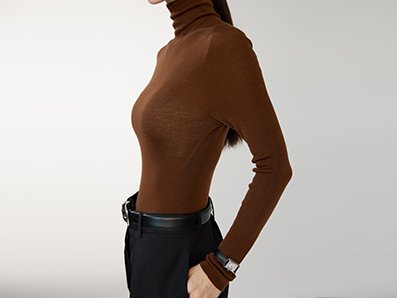
Here’s what most factories won’t tell you about 18-gauge: it’s not exotic technology. It’s just rarely needed. Most cashmere production runs on 12-16 gauge — perfectly adequate for outerwear, scarves, and standard knitwear. But for garments that sit directly against the skin, the finer the needle count, the softer the hand-feel. The Knitting Industry Association notes that gauge selection directly impacts fabric weight, drape, and skin contact comfort.
Cawool’s artisans work on complex patterns in pure cashmere year-round. 18-gauge isn’t a stretch for them — it’s their comfort zone.
Round 1: Pattern Translation
The brand provided patterns from their existing silk intimates line. The challenge? Converting a woven pattern to a knit pattern isn’t a direct translation — it requires accounting for shrinkage rates, elasticity behavior, and seam placement in an entirely different fabric structure.
The first samples arrived. The hand-feel? Perfect. The neckline and cuff finishing? Not quite. The brand wanted an invisible, seam-free edge that felt as soft as the garment body.
Round 2: Invisible Binding
Amy’s team reached into their pure cashmere shawl craftsmanship for the solution. The “invisible binding” technique — originally developed for luxury shawls where every millimeter of edge finish matters — was adapted for intimates. The result: edges that disappeared under the fingertips.
The brand approved.
Pro Tip: When converting woven patterns to knit, always account for the 3-5% shrinkage difference between fabric structures. Ignoring this leads to sizing inconsistencies that are most visible in fitted garments like intimates.
Production: 1,200 Pieces, Zero Guesswork
Each of the 24 SKUs started at 50 pieces — 1,200 pieces total. The significance of 0 MOQ here isn’t just about the number. It’s about what the number enables: the brand could match production to actual pre-order data, not forecasts.
| Metric | With Traditional MOQ | With 0 MOQ (Cawool) |
|---|---|---|
| First order size | 7,200 pieces | 1,200 pieces |
| Inventory risk | Very high | Low |
| Pre-sales (Week 1) | N/A | 800 pieces (67%) |
| Reorder timeline | 4-8 weeks | 7 days |
First week of presales: 800 pieces sold. That’s two-thirds of the entire first order, before a single piece had shipped.
Second week: the brand placed a reorder for 2,000 additional pieces.
Here’s where Cawool’s permanent archiving system delivers its real value: because every pattern, yarn specification, and process parameter is stored in the system, reorders don’t require re-sampling. The 2,000-piece reorder went from confirmation to production in 7 days. (See how archiving ensures reorder consistency in the UK boutique story.)
What This Means for Your Brand
If you’re building a product line where SKU complexity outpaces traditional MOQ economics — whether that’s intimates, kids’ wear, or any category with multiple size-color-style combinations — the math of traditional manufacturing works against you.
0 MOQ isn’t a marketing line. It’s a structural alternative to the “bet big or go home” model that has killed more emerging brands than bad design ever will. As explored in our DTC brand case study, starting small with ready-made inventory and scaling into custom production is one of the most capital-efficient paths for new brands.
“When your SKU count exceeds your MOQ, zero isn’t a minimum — it’s the only option.”
Frequently Asked Questions
What does 0 MOQ actually mean in cashmere manufacturing?
Zero MOQ means there is no minimum order quantity required. You can order as few as 50 pieces per SKU, allowing brands to test multiple styles without committing to large inventory volumes. This is particularly valuable for categories like intimates with high SKU counts.
Can 18-gauge cashmere really be worn as a base layer?
Yes. 18-gauge knitting produces an ultrafine fabric with exceptional softness against the skin. The key is using Grade A cashmere with proper tension settings — the result is a lightweight, breathable base layer that feels like a second skin rather than a heavy winter garment.
How does Cawool’s permanent archiving help with reorders?
Every pattern, yarn specification, and process parameter is permanently stored in Cawool’s digital system. When you reorder, the machine reads the exact same instructions — meaning no re-sampling is needed and production can begin within 7 days. This was critical for this brand’s 2,000-piece reorder in Week 2.
Looking for a cashmere manufacturing partner that understands high-SKU, low-volume production? Get in touch with Cawool to discuss your project.
About the Author: Cawool Studio, a cashmere knitwear manufacturer specializing in 0 MOQ production, permanent pattern archiving, and complex knitting techniques. With deep expertise in ultrafine gauge knitting and artisan craftsmanship, we has helped brands across Europe, North America, and Asia bring ambitious cashmere collections to market.
Sources:
- McKinsey State of Fashion Report, businessoffashion.com, accessed May 2026
- Textile Learner — Gauge in Knitting, textilelearner.net, accessed May 2026
- Business of Fashion — Luxury Manufacturing in China, businessoffashion.com, accessed May 2026
Pingback: DTC Cashmere: From Ready-Made to Custom Production